
Early Screenshots Reveal the Evolution of Star Wars Zero Company
New early development screenshots showcase how Bit Reactor evolved Star Wars Zero Company's tactical UI, Clone Wars battlefields, and custom operatives.
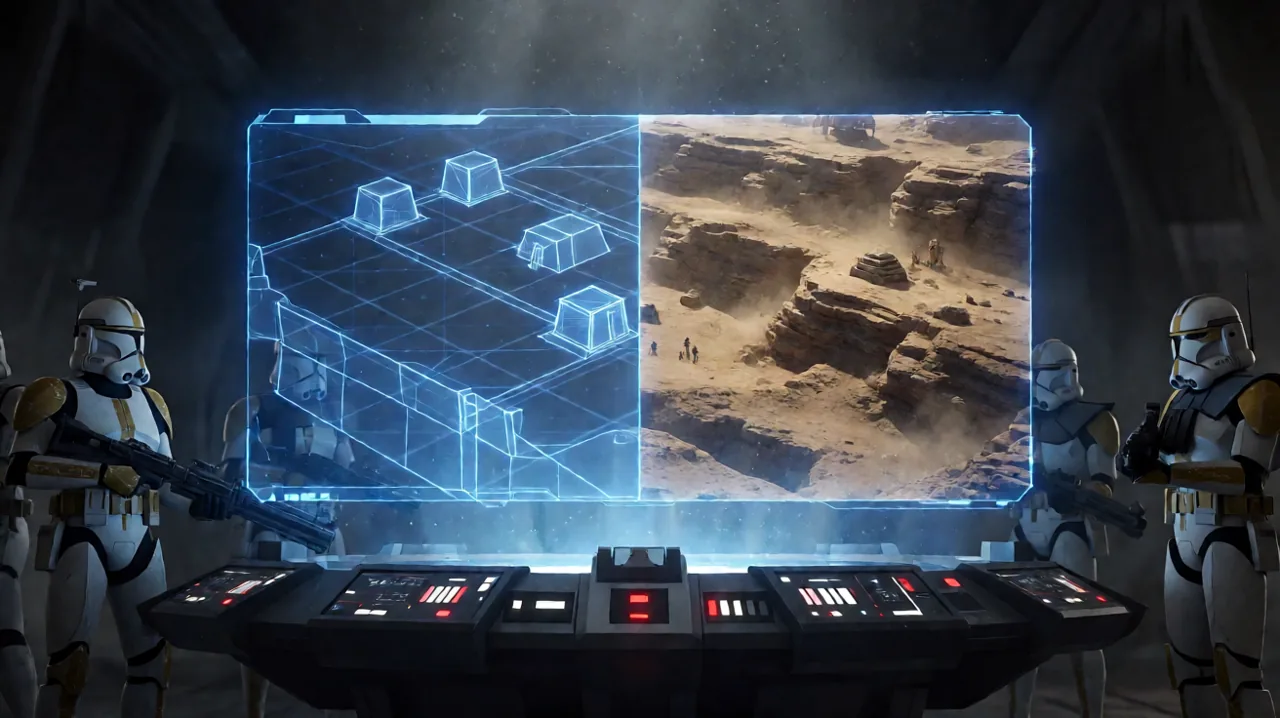
Exactly one month after its blockbuster launch on August 27, Star Wars Zero Company continues to dominate the turn-based strategy conversation. Bit Reactor’s ambitious take on the Clone Wars era (set firmly in 20 BBY) has proven that the combination of deep tactical mechanics and rich narrative customization is a winning formula.
While players are currently busy optimizing their squads and upgrading The Den, a newly surfaced batch of early development screenshots reported by Bespin Bulletin has given the community a rare look behind the curtain. These images reveal the messy, complex, and fascinating prototyping phase of the game, highlighting exactly how much the tactical UI, the environments, and the operatives evolved before the game reached its polished release state.
A Massive One-Month Milestone
Before analyzing the developmental changes, it is important to contextualize the game’s current standing. According to recent reports from Fantha Tracks, Star Wars Zero Company has officially crossed the one million copies sold milestone across PC, PlayStation 5, and Xbox Series X|S within its first month.
For a hardcore, single-player turn-based strategy game, hitting one million sales this rapidly is an immense achievement. It validates Bit Reactor’s design philosophy: treating the player’s intelligence with respect while delivering a punishing but fair combat system. The tension of managing Commander Hawks and a customizable roster of mercenaries against the forces of Kundri Fathom has resonated deeply, establishing the title as a modern benchmark for the genre. This commercial success also firmly cements the game’s turn-based tactics lineage as a worthy evolution of the systems popularized by classic strategy titles.
From Graybox Grids to the Clone Wars
Creating a balanced tactical game requires rigorous testing before any art assets are finalized. The early screenshots published by Bespin Bulletin prominently feature what developers call “grayboxing.” In these alpha builds, the visually stunning battlefields of Christophsis and Geonosis were nothing more than flat, untextured grid planes populated by brightly colored geometric blocks representing full and half cover.
This phase of development focuses entirely on the math underlying the combat fundamentals. When an operative moves to flank an enemy, the game engine needs to accurately calculate the line of sight and the reduction in the enemy’s defensive bonuses. By stripping away the visual clutter of crystal outcroppings, fungal growths, or burning Republic gunships, Bit Reactor’s designers were able to ensure that the core mechanics—movement constraints, elevation advantages, and overwatch trigger radii—functioned flawlessly.
Comparing these graybox environments to the final game is staggering. A simple blue cube from the prototype eventually became an intricately modeled piece of heavy machinery on Ryloth, providing essential cover for your sniper while dynamically taking visual damage from stray blaster fire. The early images show that the team prioritized a pristine, unbreakable ruleset for positioning before wrapping it in the high-fidelity aesthetic that defines the 20 BBY lore and era placement.
Iterating on the Tactical Interface
The heads-up display (HUD) is arguably the most critical element of any strategy game. If a player misreads their chance to hit or misunderstands how many Action Points (AP) an ability costs, the resulting permadeath of a beloved operative feels cheap rather than earned.
The early screenshots highlight a UI that was significantly heavier and more numerical than the sleek, holographic interface players navigate today. Early iterations reportedly displayed complex percentage breakdowns covering the screen, trying to communicate every modifier affecting a shot. Over time, Bit Reactor clearly realized that less is more. The final UI streamlines this data into readable probability brackets and clear crosshair indicators, allowing players to focus on the battlefield rather than doing mental arithmetic.
Furthermore, the evolution of the 3-AP system is evident. Prototype images seem to suggest an older, more rigid movement-and-action framework. The transition to the highly flexible 3-AP economy—which allows players to mix and match movement, class skills, and shooting in any order—was likely born out of these early testing phases, resulting in the fluid squad synergy that defines high-level play.
Placeholder Operatives and Voice Acting Triumphs
Perhaps the most amusing aspect of the leaked development screens is the state of the operatives themselves. Long before players were agonizing over their classes and operative roles, the early builds utilized generic, featureless clone models and untextured alien meshes to test squad dynamics. The distinct visual identity of the various diverse species in the game was applied much later in the process.
This visual evolution runs parallel to the game’s audio development. In the final release, the operatives are not just tactical chess pieces; they are fully realized characters with distinct personalities, banter, and backstories. This week, TSG Management publicly celebrated the return of veteran voice actor D.C. Douglas (widely known for his work in Jedi: Survivor) to the Star Wars universe. Douglas voices Meevo, one of the many standout characters that players can recruit.
Seeing the sterile, T-posing models in the early screenshots reinforces how crucial voice performances like Douglas’s are to the final product. The emotional weight of losing an operative to permadeath is drastically amplified when that operative has been actively communicating with Commander Hawks and reacting to the chaos of a botched ambush, rather than just existing as a silent set of stats.
The Foundations of The Den
Finally, the screenshots provide a glimpse into the early conceptualization of The Den, Zero Company’s upgradable headquarters. Initially, the base appears to have been envisioned as a series of simple 2D menus where players allocated resources and selected the next operation.
Bit Reactor eventually pivoted to the fully rendered, navigable 3D space we have now. This shift was monumental for pacing. Returning to The Den after a grueling, multi-phase operation on Umbara allows the player to decompress. Walking through the armory, checking on injured squadmates in the medbay, and upgrading weaponry in a tangible space grounds the campaign, making the progression feel earned.
A Triumph of Iteration
Game development is rarely a straight line. The transition from blocky, graybox grids and cluttered UI elements to the immersive, mechanically airtight experience of Star Wars Zero Company is a testament to the power of iteration. Bit Reactor recognized that the foundation of a great strategy game is an uncompromising ruleset, and they built the visual and narrative layers securely on top of that framework.
As the community continues to push the boundaries of squad builds and zero-casualty runs, looking back at these early screenshots serves as a potent reminder of the massive effort required to bring this corner of the Clone Wars to life.