
Community Debate: Does Star Wars Zero Company Struggle With Mid-Game Repetition?
Players debate the mid-game pacing of Star Wars Zero Company, exploring the Cycle 12 slump, the anticipated Cycle 18 Dual Specialization, and difficulty spikes.
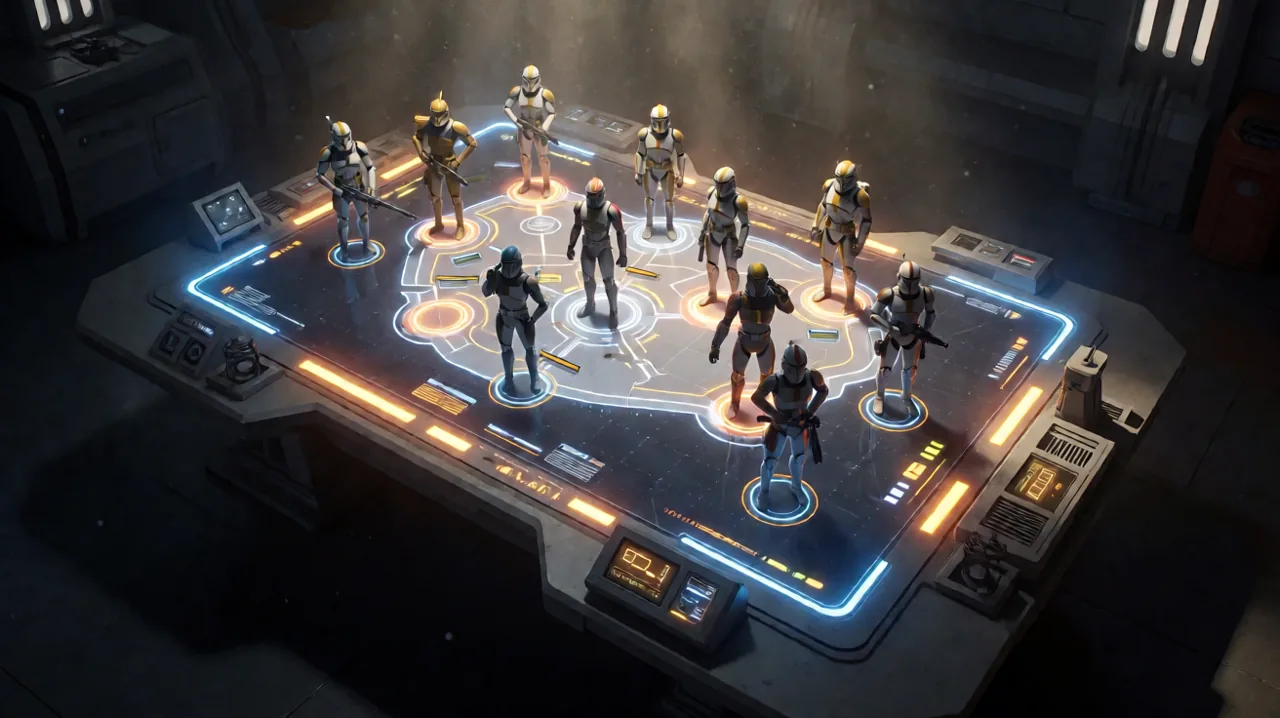
It has been roughly a month since Bit Reactor and Electronic Arts launched Star Wars Zero Company, thrusting players into the grim, tactical realities of the Clone Wars era. As the community digs deeper into the 30-to-40-hour campaign, a noticeable shift in discussion has occurred. The initial awe of commanding a fully customized mercenary squad—recruiting diverse operatives from across the galaxy and upgrading their gear in the Den—has settled into a rigorous analysis of the game’s core loop. For many turn-based strategy veterans and newcomers alike, a specific hurdle has emerged around the eight-hour mark: the mid-game pacing slump.
Recent community discussions have highlighted a distinct plateau in difficulty and tactical variety that hits around Cycle 12. Players executing operations on planets like Christophsis or Geonosis are reporting that the encounters begin to feel overly familiar if they are playing on the default Normal difficulty setting. However, there is a light at the end of the hyperlane. Community reports point toward a significant mechanical shift that occurs at Cycle 18, introducing an anticipated “Dual Specialization” feature. Furthermore, the game’s stellar narrative presentation and voice acting—recently highlighted by a major Golden Joystick nomination—are providing the necessary momentum to carry players through the slower segments of the campaign.
The “Cycle 12 Slump” and the Pitfalls of Normal Difficulty
In turn-based tactical games, pacing is everything. Star Wars Zero Company asks you to manage Hawks and a diverse roster of operatives, constantly balancing the immediate threat of combat with long-term progression. However, a growing consensus among the community suggests that the default Normal difficulty may not push players hard enough to engage with the game’s deepest systems.
By the time a campaign reaches Cycle 12—which generally equates to about eight hours of playtime—many players find themselves settling into a comfortable, albeit static, rhythm. The combat loop of establishing solid cover, utilizing overwatch lines, and setting up flanking maneuvers is the bread and butter of the experience. But on Normal difficulty, the enemy AI rarely punishes suboptimal positioning. Some players have noted that they have never lost a mission by this point, and their core four operatives have never even come close to falling in battle.
This lack of friction creates a domino effect across the game’s meta-layer. If your primary squad is never wounded, there is absolutely no incentive to rotate them out. The tension of managing a deep bench of operatives, heavily emphasized in our how permadeath works analysis, completely evaporates. You stop visiting the barracks in the Den to check on your B-team. You stop experimenting with risky, unconventional setups because the standard assault-and-overwatch approach works every single time. Upgrades begin to feel like minor statistical bumps—a slight increase to blaster damage or a minor boost to health—rather than transformative new tools that alter your battlefield approach. For a game that draws heavy inspiration from genre giants, having the tactical layer stagnate this early is a legitimate concern for campaign longevity.
Narrative Momentum and Golden Joystick Recognition
So, what is keeping players engaged when the combat encounters start to blur together? The answer lies in the impeccable world-building and character interactions. Even when the tactical puzzle feels solved, the narrative drive of Star Wars Zero Company remains a massive draw. The dynamic banter between your operatives during missions, the quiet moments of reflection in the base, and the overarching threat of Kundri Fathom provide a rich layer of context that elevates the standard grid-based combat.
This narrative strength was recently validated on a much larger stage. It has been officially confirmed that Vic Michaelis, who delivers a standout voice performance in the game, has been nominated for Best Supporting Performance at the upcoming Golden Joystick Awards. This nomination is a testament to the incredible talent Bit Reactor brought on board to flesh out the game’s original cast. Players on social media have consistently praised the voice acting as a major highlight, noting that the distinct personalities of their recruited mercenaries make the squad feel alive. When you are trudging through your fifth operation in the humid, glowing fungal forests of Felucia, it is often the dynamic dialogue and emotional investment in these characters that make the mission worthwhile. The story and setting of the game are proving to be just as crucial as its action point economy.
The Cycle 18 Turning Point: Dual Specialization
For those who are feeling the fatigue of the mid-game loop, veteran players and community trailblazers are urging patience. According to extensive community reports, a major paradigm shift occurs precisely at Cycle 18. This is reportedly the milestone where a new “Dual Specialization” system is unlocked, completely altering the trajectory of your operatives’ progression.
Up until this point, players generally adhere to strict class roles. A heavy gunner focuses on suppression and area denial, while a scout is optimized for mobility and flanking. But Dual Specialization reportedly shatters these rigid boundaries. While the exact numerical permutations are still being mapped out by theorycrafters, the implication is that you can begin cross-pollinating skill trees. Imagine taking an operative from your best squad composition who excels at frontline assault and weaving in the restorative or tactical buffing abilities of a support class.
This system effectively answers the complaint that mid-game upgrades feel like simple number adjustments. By allowing operatives to branch out, players are forced to rethink their entire approach to squad synergy. A character might be able to trigger an overwatch shot with a heavy repeating blaster, and then immediately utilize a secondary class ability to relocate to high ground without triggering an enemy’s reaction fire. If these community reports hold true, Cycle 18 represents the moment the training wheels come off, granting commanders the freedom to construct highly specialized hybrid combatants capable of handling the escalating threats of the late campaign. It adds a dense layer of customization that strategy veterans crave, dramatically expanding the utility of our all classes guide.
Rethinking Difficulty: Should You Switch to Hard or Expert?
If you find yourself stuck in the Cycle 12 slump and cannot wait until Cycle 18 to feel challenged, there is an immediate solution available in the settings menu: raise the difficulty. A significant portion of the community debate centers on whether switching to Hard or Expert actually fixes the repetition, or if it merely inflates enemy health pools, making fights longer but not necessarily more engaging.
Early community consensus suggests that increasing the difficulty does, in fact, revitalize the tactical layer, primarily by changing enemy behavior. On Hard and Expert, the opposing forces do not just blindly walk into your overwatch traps. They actively seek to destroy your cover, utilize their own flanking maneuvers, and focus fire on your most vulnerable operatives.
When the enemy fights smarter, you are forced to play smarter. That standard four-person squad that coasted through Normal difficulty will suddenly start taking casualties. Operatives will require recovery time in the medbay, forcing you to engage with the Den’s recruitment mechanics and level up your reserve fighters. You will have to carefully manage your action points, deciding whether to take a low-percentage shot or spend that AP to hunker down and survive the next barrage.
Transitioning to a higher difficulty essentially re-activates the game’s dormant survival mechanics. It makes the threat of losing an operative a tangible reality, which in turn makes every tactical decision carry actual weight. For more advice on navigating these punishing encounters, be sure to brush up on our combat tactics guide.
Looking Ahead
Star Wars Zero Company is a massive, ambitious title that successfully blends a deeply personal, character-driven narrative with the unforgiving mechanics of classic turn-based tactics. It is not entirely surprising that a lengthy campaign might experience a lull in its pacing. However, the ongoing community discourse proves that the game has the systemic depth to recover.
Whether you choose to power through the comfortable repetition of Normal difficulty to reach the promised land of Cycle 18’s Dual Specialization, or you decide to test your mettle by raising the difficulty to Expert immediately, the tools to adjust your experience are readily available. With award-nominated performances keeping the story engaging, Hawks and Zero Company still have plenty of fight left in them. As players push further into the late game, it will be fascinating to see what other mechanical secrets Bit Reactor has hidden in the back half of the Clone Wars.