
Community Discoveries in Star Wars Zero Company: The GONK Advantage Economy and Halloran Lore
A month after launch, the Star Wars Zero Company community is uncovering the tactical depths of the GONK Advantage economy, Droid operatives, and hidden lore.
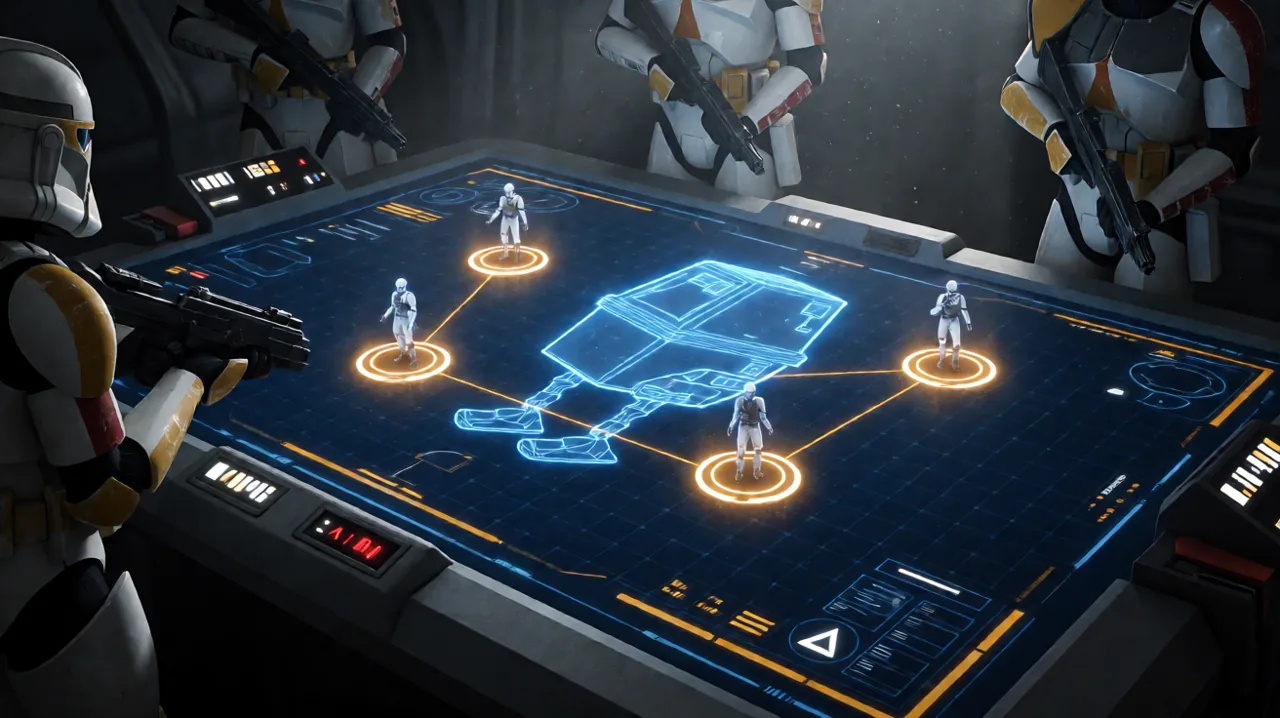
A bit over a month after its highly anticipated launch on PC, PlayStation 5, and Xbox Series X|S, Star Wars Zero Company continues to dominate the strategy gaming conversation. Bit Reactor’s ambitious foray into the Clone Wars era has proven to be a masterclass in atmospheric storytelling and punishing turn-based tactics. While the initial wave of release-window coverage focused heavily on mastering the basics of cover, action points, and survival against the Kundri Fathom syndicate, the community has now transitioned into the deeply analytical phase of the game’s lifecycle. Veteran commanders operating out of the Den are dissecting the finer mathematical details of the game’s systems, leading to fascinating discoveries about squad synergies and resource management.
Recent community reviews and deep-dive discussions have brought several nuanced topics to the forefront: the puzzle-like nature of the “GONK Advantage economy,” the meticulous balancing of Droid operatives, and some unexpected lore connections surrounding a recruit named Bennic Halloran. As players continue to push the boundaries on the highest difficulties, understanding these underlying mechanics is proving to be the difference between a triumphant extraction and a devastating squad wipe.
The Tactical Puzzle: Decoding the GONK Advantage Economy
One of the most defining and hotly debated constraints in Star Wars Zero Company is the strict limitation of fielding only four active operatives per deployment. Unlike other staples of the turn-based strategy genre that eventually allow you to field six or more soldiers as the campaign progresses, Hawks’ customized Zero Company squad must always rely on a tight, cohesive four-person fireteam. This restriction places immense pressure on every single Action Point (AP) generated during a turn. To compensate for the severe numerical disadvantage against sprawling Separatist droid armies and Kundri Fathom enforcers, Bit Reactor implemented a system that the community has affectionately dubbed the “GONK Advantage economy.”
According to seasoned strategists who have been running intense campaigns on Expert difficulty, this system acts as a sophisticated, puzzle-solving layer during tactical combat. While the exact under-the-hood calculations are still being theorycrafted by the community, the core concept revolves around utilizing support actions—often provided by deployed GONK droids, specific environmental interactions, or specialized operative abilities—to generate a tactical resource known as “Advantage.” Instead of simply trading blaster fire from behind full cover and hoping for favorable hit-chance rolls, players must actively manage this economy.
Advantage can reportedly be spent to manipulate the battlefield in ways that raw AP cannot. It might be used to guarantee a critical flanking shot, strip heavy armor off a priority target, or provide a temporary defensive buff that mitigates the inherent risks of half-cover on chaotic battlefields like the fungal forests of Felucia or the crystalline plains of Christophsis. In a game where establishing overlapping overwatch arcs and maintaining high-ground dominance are mandatory for survival, the GONK Advantage economy transforms standard firefights into calculated tactical puzzles. Commanders must constantly weigh the immediate gratification of dealing direct damage against the strategic investment of generating Advantage to set up a devastating, multi-operative synergy on the following turn. It is a brilliant design choice that ensures the player always has interesting, high-stakes decisions to make, perfectly compensating for the smaller squad size.
Forging the Perfect Squad: Droids and Class Balance
Closely tied to the mechanics of the Advantage economy is the game’s robust class system and the integration of non-organic operatives. In many Star Wars titles, droids are frequently relegated to background scenery, comic relief, or overpowered novelty characters that break the game’s established rules. Zero Company, however, strikes an incredibly delicate balance. Whether you are fielding a specialized astromech to slice terminal networks and control the battlefield environment, or deploying a repurposed security droid to act as a frontline vanguard, they feel authentically designed and heavily integrated into the tactical sandbox.
Community reviews have highlighted that Droid classes provide distinct utility that is highly valuable, yet never absolutely mandatory. They possess unique defense thresholds and armor mechanics that make them durable under heavy fire, but their lack of biological synergy with certain organic support classes ensures they cannot single-handedly win a mission. This design philosophy permeates the entire roster. Among the twelve available classes, players report that each feels like it has a definitive, useful role, and the overall balance is exceptionally tight. The damage numbers and health pools are meticulously tuned; the mathematics of combat dictate that maximizing your expected damage output through smart positioning, height advantage, and flanking always trumps relying on raw stats or a single “overpowered” class.
The defense mechanics, in particular, feel impactful without being oppressive, forcing players to think critically about how to approach entrenched enemies. For commanders struggling to find the right mix of organic and mechanical units to tackle the campaign, reviewing the best squad composition and consulting a class tier list can provide a solid foundation for building a team capable of surviving the late game.
The Halloran Lineage: Lore Connections and Bennic
Beyond the demanding tactical grid, Star Wars Zero Company serves as a treasure trove for deep lore enthusiasts. Set in 20 BBY during the height of the Clone Wars, the game allows Hawks to recruit a vast array of mercenaries, bounty hunters, Republic defectors, and independent operatives from across the galaxy. Recently, eagle-eyed fans combing through the recruitment pool at the Den have latched onto one specific, recurring operative name: Bennic Halloran.
The surname Halloran immediately triggered alarms for fans intimately familiar with the wider Star Wars canon. Griff Halloran is a notable character from the animated series Star Wars Resistance, and is also generating buzz in discussions surrounding the upcoming Galactic Racer title. Given the meticulous attention Bit Reactor has paid to Wookieepedia and overarching canon consistency, players are actively speculating whether Bennic is a direct ancestor of Griff. While the developers have not officially confirmed this familial link, the Star Wars franchise possesses a long, rich history of connecting disparate eras through bloodlines and legacy names.
Discovering operatives like Bennic in your barracks adds a profound layer of roleplaying depth to the campaign. It makes the game’s mechanics feel significantly heavier when you realize you might be sending the ancestors of future heroes into a lethal crossfire. It is these small narrative touches that elevate Zero Company from a standard tactical simulator into a lived-in piece of the Star Wars universe.
Bexpert Runs, Courtsilius, and The Beskar Mode Conundrum
As the player base matures, the most dedicated commanders are pushing the game to its absolute limits. The community has coined the term “Bexpert” to describe campaigns played on Expert difficulty with Beskar Mode enabled. Beskar Mode is Zero Company’s equivalent of an Ironman mode, featuring a strict, single-file auto-save system that makes every tactical blunder permanent. These Bexpert runs are proving to be the ultimate crucible for tactical acumen.
Players frequently share harrowing tales from the late-game chapters. Specific deployments, such as the grueling Courtsilius mission, have earned a reputation as graveyard sites for beloved, high-ranking operatives. Commanders recount devastating stories of losing veteran squad members like Jae in the muddy trenches of Courtsilius, only to barely survive a desperate, teeth-clenching boss encounter against the fearsome Kundri Fathom commander known as Visser. The defense values and enemy AI in these late-game encounters are punishing; a single miscalculated flank or a missed overwatch trigger can rapidly spiral into a complete squad wipe. If you find yourself repeatedly losing your best soldiers, our comprehensive breakdown on how permadeath works offers crucial strategies for mitigating catastrophic losses and rebuilding your roster from the Den.
However, this hardcore pursuit of the Platinum trophy and full achievement completion has unfortunately hit a technical snag. Because Beskar Mode relies entirely on a single auto-save file, intermittent bugs and system crashes—particularly reported by PC and PlayStation 5 users—have occasionally corrupted saves or halted progress entirely. The community is understandably frustrated; trophies requiring a full Beskar completion have become a source of anxiety for those who have lost 40-hour campaigns not to a tactical error against Visser, but to an unexpected desktop crash. While Bit Reactor has been diligent with patches, the community is highly vocal about the need for immediate stability updates to ensure that Beskar mode remains a pure test of skill rather than a gamble on system stability.
Looking Ahead: The Call for New Game Plus
The sheer quality of the core gameplay loop—bolstered by phenomenal voice acting, an authentic Clone Wars atmosphere, and uncompromising tactical combat—has left players overwhelmingly hungry for more content. While the base campaign provides a substantial 30 to 40-hour experience, veteran commanders who have mastered the Advantage economy and conquered the Bexpert difficulty are actively petitioning Bit Reactor for a dedicated New Game Plus (NG+) or an expanded, endless RPG sandbox mode.
Once the primary narrative concludes, players desperately want to continue operating out of the Den. The community envisions a post-game state where they can continually recruit new operatives, experiment with unorthodox class synergies, and test their fully leveled squads against infinitely scaling, procedurally generated contracts across the galaxy map. Whether Bit Reactor will answer this call with a major post-launch content update remains an open question. Nevertheless, the fervent demand itself is a powerful testament to how deeply Star Wars Zero Company has resonated.
As we continue to refine our tactics and uncover hidden lore, it is clear that Zero Company has firmly established a formidable, lasting beachhead in the strategy gaming landscape.