
Zero Company Dominates August Revenue Charts Amid 'Strategist vs. Wildcard' Tactical Debates
Bit Reactor's hit secured No. 6 in PC revenue in just five days. Discover how deep 3-AP mechanics, wildcard flanking, and operative attachments are driving its massive success.
Bit Reactor and Respawn Entertainment have achieved what many analysts thought was highly improbable in today’s gaming landscape: turning a deeply complex, XCOM-like tactical strategy game into an overnight commercial juggernaut. Released on August 27 for PC via Steam (app id 2075800), PlayStation 5, and Xbox Series X|S, Star Wars Zero Company has commanded the attention of the global player base.
Newly released market data from Newzoo provides a startling picture of just how massive this launch was. The title secured the number six spot for PC revenue across major US and European markets in August. What makes this metric extraordinary is that the game only had five days on the market before the tracking month ended. Supported by reports confirming it crossed the 1 million copies sold milestone rapidly, it is evident that the demand for a punishing, cerebral turn-based experience set during the Clone Wars was vastly underestimated.
But phenomenal sales figures only tell half the story. The reason Zero Company is maintaining its momentum and dominating online discourse lies in its mechanical depth. The community is currently locked in a fascinating debate regarding optimal playstyles, highlighted by recent official showcases focusing on the “Strategist vs. Wildcard” approaches to combat.
The Anatomy of the 3-AP System
Before dissecting the differing tactical philosophies, it is crucial to understand the mechanical foundation that makes them possible: the 3-Action Point (AP) system. Traditional tactics games often lock players into a rigid “move-then-shoot” binary that limits creative expression on the battlefield. Zero Company shatters this limitation completely.
Having three AP to distribute across your operatives allows for highly granular decision-making. A commander can spend one AP to move into half-cover, another AP to fire a primary weapon, and the final AP to activate a defensive class skill, lob a thermal detonator, or reposition again to break enemy line-of-sight. This granular economy is the beating heart of every encounter against the forces of Kundri Fathom. Mastering how to stretch these three points across your squad to generate maximum synergy is what separates novice commanders from elite tacticians. Players looking to optimize their AP usage and class combinations should consult our Combat Tactics Guide for advanced mathematical breakdowns.
The Strategist Doctrine: Mastering the Grid
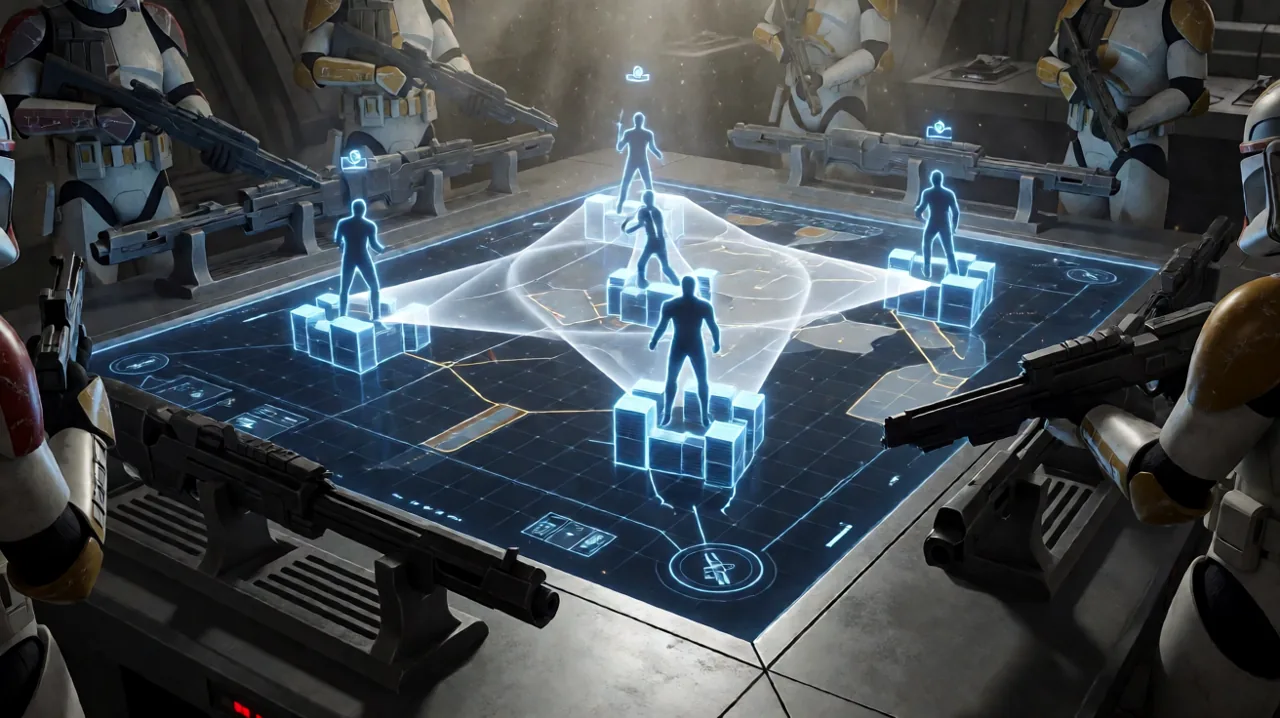
For players leaning into the “Strategist” doctrine, survival relies on meticulous grid management and minimizing variance. This approach treats the battlefield as a lethal puzzle where patience is the ultimate weapon. The core tenet of the Strategist is utilizing full cover and establishing interlocking overwatch cones to force the enemy AI to make fatal mistakes.
Instead of rushing forward to secure objectives, a Strategist carefully maneuvers their heavy clone operatives and defensive specialists into fortified positions. By overlapping fields of fire, they create an impenetrable kill zone. When enemies push forward, the reaction fire tears them apart before they can even consume their own AP. This methodical approach is incredibly effective on open maps with long sightlines. On the shattered crystal plains of Christophsis, pushing too fast often results in an entire squad being caught in the open with no viable cover. The Strategist relies heavily on support classes to generate protective buffs, ensuring that every mercenary and trooper is mutually protected. It is a slow, grinding advance that prioritizes the lives of the squad over operational speed.
Embracing the Wildcard Philosophy
Conversely, the “Wildcard” approach throws caution out the airlock in favor of aggressive, high-risk, and high-reward maneuvers. Instead of waiting for Kundri Fathom’s forces to dictate the pace of the engagement, a Wildcard commander actively pushes the flank to dismantle enemy formations before they can entrench.
This playstyle demands a deep understanding of line-of-sight manipulation and mobility-focused abilities. The Wildcard strategy often utilizes highly specialized operatives who can traverse the map vertically, bypass heavy cover entirely, or disrupt enemy overwatch states with specific gear loadouts. When navigating the dense, bioluminescent fungal forests of Felucia, securing a flanking angle can completely negate a target’s defensive rating, turning a grueling firefight into a swift execution.
However, the Wildcard approach is a chaotic ballet. Relying on aggressive pushes means leaving operatives exposed if a shot misses or an enemy reinforcement pod drops unexpectedly. To succeed with this aggressive doctrine, commanders must heavily research weapon modifications and mobility enhancements back at their base. For recommendations on building an aggressive roster, review our Best Squad Composition recommendations.
Operative Spotlights: The Bennec Halloren Phenomenon
Regardless of whether you play as a patient Strategist or a reckless Wildcard, the execution of these tactics relies entirely on your custom squad. Operating from The Den—your central hub and base of operations—Commander Hawks must recruit, train, and equip a diverse roster of characters.
The community’s engagement with these operatives has transcended mere stat-tracking. Because the game utilizes strict permadeath mechanics, players are forming intense emotional attachments to their recruits. A prime example currently dominating Reddit discussions is Bennec Halloren.
Players have widely noted Halloren’s rigid, “by the books” demeanor, which slowly cracks through camp interactions to reveal a fiercely loyal and surprisingly friendly core. Community threads are filled with stories of his clutch performances, particularly during the grueling “Stillwatch mission,” a mid-game operation that severely tests squad endurance. Players aren’t treating these units as disposable pawns; they are integral members of Zero Company. Sending a beloved operative like Halloren into a dangerous flanking position on the shadow-drenched battlefields of Umbara carries genuine tension because his survival is entirely dependent on your tactical foresight. If you are struggling to keep your favorite recruits alive, understanding the nuances of the injury system is paramount, as detailed in our How Permadeath Works overview.
Narrative Debates: The Shadow of Order 66
While the tactical combat, the AP economy, and the depth of squad management are receiving near-universal praise, the game’s overarching narrative has sparked spirited debate among the player base.
Zero Company is set strictly in 20 BBY, placing it squarely in the middle of the Clone Wars era. The primary narrative arc focuses on Commander Hawks establishing a foothold and leading the fight against the newly introduced antagonist faction led by Kundri Fathom. However, community discussions have recently erupted regarding the thematic inclusion of Order 66 elements and foreshadowing within the campaign.
According to community feedback, some fans expected a narrative completely isolated from the inevitable tragedy of the Jedi fall. These players prefer to focus solely on the immediate brotherhood of the clone troopers and the grit of mercenary life on the outer rim. The presence of darker plot threads that point toward the rise of the Empire has divided opinions. Some players appreciate the dramatic irony and the heavy tension it adds to the broader Star Wars lore, arguing that you cannot tell a story in 20 BBY without acknowledging the looming betrayal. Others argue that the Star Wars gaming landscape needs a break from the Order 66 timeline, wishing that Zero Company had remained entirely focused on localized military operations.
Perfecting the Loop in The Den
Ultimately, the debates surrounding narrative choices and optimal combat doctrines only highlight how deeply engaging the core loop of Zero Company truly is. Everything circles back to The Den. The credits and intel earned through a flawless Wildcard flank on Geonosis feed directly into upgrading your medical bay, ensuring your Strategist heavy weapons expert recovers faster from a plasma burn.
The incredible August revenue numbers generated in just five days prove that Bit Reactor has tapped into a massive audience hungry for uncompromising tactical depth. As players continue to map out every class synergy and unlock the ultimate potential of their custom operatives, the meta will only continue to evolve. To ensure your squad is prepared for the late-game difficulty spikes, brushing up on the strengths and weaknesses of your recruits via our All Classes Guide remains the smartest tactical decision a commander can make.