
Three Weeks Later: The Push for a Sandbox Mode, $28M Launch Week, and Expert Platinum Runs in Zero Company
With Star Wars Zero Company crossing a reported $28 million in launch week revenue, veteran players are completing their Beskar runs and demanding one crucial addition: an endless sandbox mode.
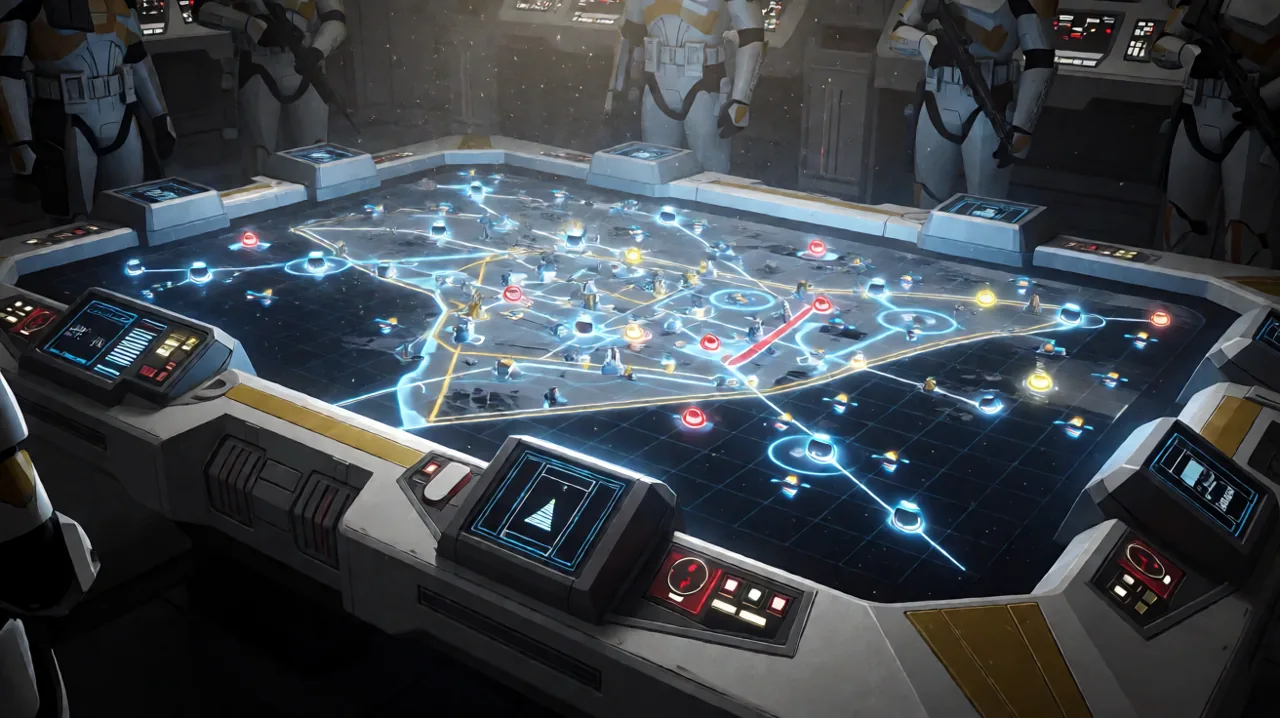
It has been roughly three weeks since Bit Reactor and Electronic Arts deployed Star Wars Zero Company onto PC (Steam app 2075800), PlayStation 5, and Xbox Series X|S. The dust is finally beginning to settle on the battlefields of the Clone Wars, and the data paints a picture of a massive success for the turn-based tactics genre.
According to a recent report by Bespin Bulletin, the game pulled in an estimated $28 million during its launch week alone, cementing its status as a heavy hitter for EA this fiscal year. As a direct result of this financial momentum, the same outlet reports that the developers are already holding internal discussions about potentially bringing the game to additional platforms in the future.
But what happens after the honeymoon phase ends? As the earliest adopters finish their campaigns and return to the Den to tally their losses against Kundri Fathom’s forces, a clear consensus is forming among the veteran strategy community. The tactical depth is phenomenal, the writing is top-tier, but the game is missing one critical feature that could elevate it to a timeless masterpiece: a dedicated sandbox mode.
Here is a look at the state of Zero Company three weeks post-launch, the grueling reality of the 100-hour Platinum grind, and the bizarre Easter eggs the community has unearthed while waiting for the next major patch.
The 100-Hour Road to Platinum and the Beskar Grind
For those who treat turn-based strategy games as a mathematical puzzle to be solved, Zero Company has provided a brutal, satisfying playground. Early estimates suggested a standard campaign would run between 30 to 40 hours. However, trophy hunters and hardcore tacticians are finding out exactly how much time is required to truly conquer the galaxy.
According to community reports, unlocking the Platinum trophy (or full 100% achievements on Steam/Xbox) is clocking in at around 100 hours of playtime. A massive chunk of this time is dedicated to the notorious Expert difficulty run with the Beskar mode modifier enabled. Beskar mode is the game’s ironman variant—meaning no manual saving, and all mistakes are permanent. A single Expert+Beskar campaign takes roughly 50 hours of meticulous planning, assuming you don’t suffer a squad wipe halfway through Ryloth.
On this difficulty, basic mechanics are no longer optional. If you aren’t strictly utilizing full cover, setting up overlapping fields of overwatch fire, and executing flanking maneuvers to bypass enemy armor ratings, your operatives will die. To succeed, you have to maximize the 3-AP (Action Point) system and ensure your class synergies are firing on all cylinders.
However, these marathon runs are not without their frustrations. Multiple players attempting the Expert+Beskar gauntlet have noted persistent stability issues, particularly on the PS5 and Steam Deck. Random camera hitches, late-game freezing, and occasional hard crashes can artificially ruin a flawless operation. While the auto-save system usually kicks in at the start of a turn, having the game freeze while your Heavy Gunner is setting up an essential suppression zone is a tension spike nobody asked for. If you are attempting this run, you might want to review our permadeath mechanics breakdown to understand exactly when the game logs a casualty.
The Umbara Pivot and Operative Praise
When looking back at the narrative arc of Zero Company, players are heavily praising the game’s pacing—specifically pointing to a major tonal shift that occurs roughly halfway through the campaign.
Many users in the community have noted that the early missions on Christophsis and Geonosis, while mechanically sound, feel like standard Clone Wars fare. However, once Hawks and Zero Company touch down on the shadowy, hostile surface of Umbara, the plot heavily accelerates. Players note that the writing during and after the Umbara operations is where the game truly shines, blending the best elements of the expanded universe with sharp, character-driven storytelling.
The undeniable heart of the game, however, is the operatives themselves. Strategy veterans are universally praising the authored characters that join the Den. Names like Kabbney “Kabb” Uppercut, Trick, and Luco Bronc have quickly become fan favorites, boasting unique dialogue and interpersonal dynamics that make the barracks feel alive.
Even more impressive is how Bit Reactor handled the procedurally generated recruits. Players are reporting that their custom-made operatives—whether they are twi’lek snipers or trandoshan brawlers—develop “lived-in personalities” over time through the game’s bonding system. It ensures that when an operative falls in combat, the loss feels personal, rather than just losing a spreadsheet of stats.
The Growing Demand for a Sandbox Mode
Despite the glowing praise for the combat loop and character writing, the most common criticism surfacing three weeks post-launch is that the campaign is simply too rigid for the mechanics it offers.
Players love the core loop: deploying from the Den, utilizing action points, flanking droids, and watching their custom squad grow. But because the campaign follows a linear narrative structure, it eventually has to end. Furthermore, veterans are pointing out that the late-game suffers from surprisingly thin enemy and weapon variety, and a customization system that heavily favors Clone Troopers over the various alien species.
This has led to a massive, coordinated push from the community requesting a “Sandbox” or “Endless” mode. Players want a persistent galactic map where they can continue taking randomized contracts, managing the Den’s finances, and leveling up new recruits indefinitely without the looming pressure of Kundri Fathom’s storyline forcing an endgame scenario.
To compensate for the lack of a sandbox, players are already creating their own community challenges to artificially inflate replayability. We are seeing full single-class runs, single-race mercenary companies, and even absurd challenge runs where players recruit entirely clone squads and name them strictly after 1980s sci-fi B-movie characters (the infamous Mystery Science Theater 3000 “Space Mutiny” clone run is currently gaining traction on Reddit).
For many fans, a post-launch update introducing a sandbox environment is the only thing standing between Zero Company being a great 9/10 game and becoming the undisputed greatest turn-based strategy game of all time.
VR Bacta Sprays and KFC Droids: Community Discoveries
When thousands of players are scouring every inch of a tactical grid for cover, they tend to notice small environmental details. Over the past few days, data-miners and eagle-eyed fans have uncovered some hilarious Easter eggs and behind-the-scenes development shortcuts.
The first major discovery revolves around the game’s standard medical equipment. A player realized that the 3D model used for the “Trauma Kit” item in Zero Company is the exact same high-resolution asset used for the Bacta Spray in the virtual reality title Star Wars: Tales from the Galaxy’s Edge. Whether this is an intentional nod to the broader gaming universe or simply a case of Lucasfilm Games intelligently pooling assets across different development studios to save time, it is a neat connection that grounds the equipment in the established lore.
The second discovery is significantly less serious. When diving into the customization options for astromech and utility droids back at the Den, players stumbled upon “Custom Droid Preset 2.” Its stout, cylindrical shape and oddly patterned plating immediately drew comparisons to a real-world fast-food staple. The community has universally dubbed this preset the “KFC Bucket Droid,” with some players going as far as painting it red and white, outfitting it with repair tools, and designating it with the callsign “KFC-KC11” for their frontline operations.
As Bit Reactor works on their next round of stability patches, the community remains deeply engaged. The combat fundamentals have proven they can easily support hundreds of hours of gameplay. Now, all eyes are on the developers to see if they will deliver the endless sandbox experience the veterans are begging for.