
Zero Company Community Weighs In: The Den's Perfect Pacing vs. The Infinite Coil's Missed Potential
As players conquer the late-game, the Zero Company community is praising the streamlined hub pacing of The Den while debating the underwhelming mechanics of Hawks' Resonance infection.
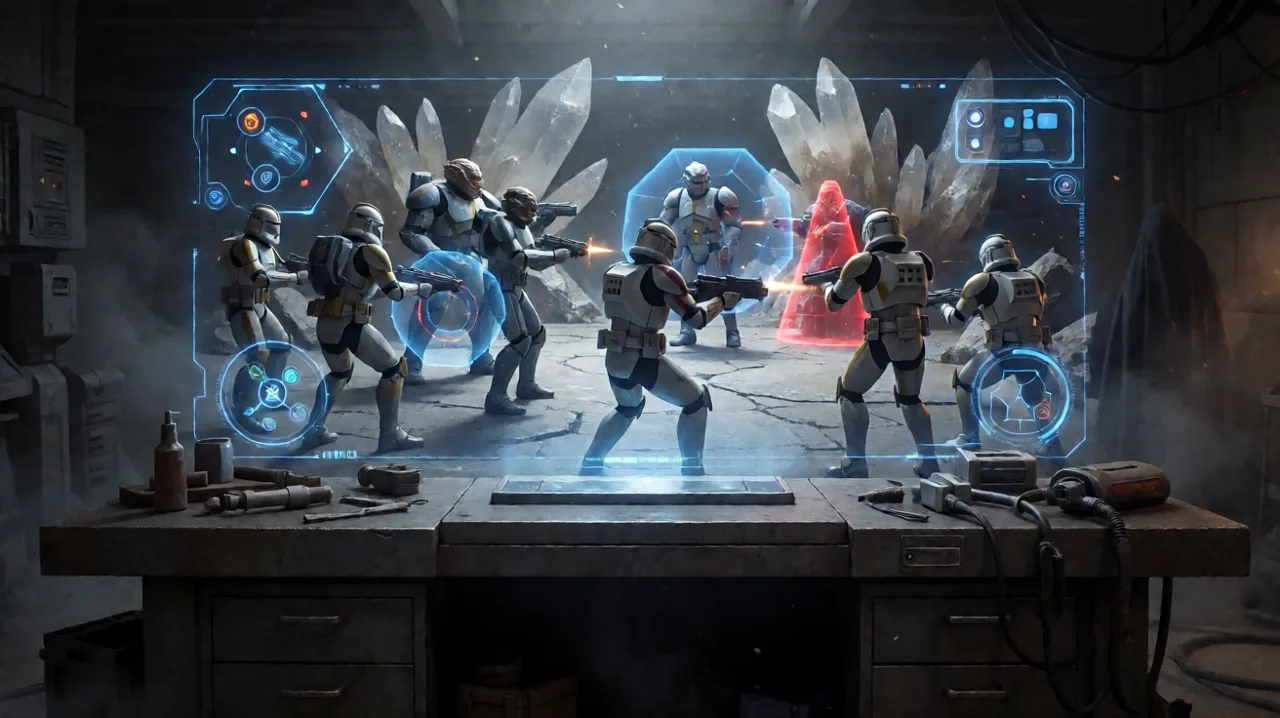
It has been nearly a month since Star Wars: Zero Company launched on PC and current-generation consoles, and the dust is finally settling on Bit Reactor’s ambitious vision for the tactical strategy genre. Strategy veterans have spent the past few weeks thoroughly dissecting the 40-hour campaign, pushing their customized squads of clone troopers, Jedi, and diverse alien mercenaries to the absolute limit across battlefields like Christophsis, Geonosis, and the shadowy depths of Umbara.
With the initial wave of release excitement stabilizing, the community’s focus has naturally shifted toward analyzing the deeper intricacies of the late-game experience. Over the last few days, discussions across forums and Reddit have crystallized around two major talking points: widespread praise for the remarkably restrained pacing of the game’s central hub, The Den, and a growing debate over the mechanical execution of the late-game Infinite Coil antagonist faction—specifically, the much-discussed “Resonance” mechanic tied to the protagonist, Hawks.
The Den: A Masterclass in Tactical Hub Pacing
In recent years, the turn-based tactics genre has heavily leaned into robust hub-world experiences. Titles like Fire Emblem and Marvel’s Midnight Suns require players to spend significant portions of their playtime navigating social simulators, giving gifts, and participating in mundane activities to boost squad performance. While this approach has its fans, it can often disrupt the momentum of a military campaign.
Star Wars: Zero Company takes a distinctly different approach with its customizable base, The Den. Recent community threads highlighted exactly why this design choice is resonating so strongly with the hardcore strategy crowd. In a discussion evaluating various tactical RPGs, a player specifically cited Zero Company as the gold standard for respecting the player’s time.
“I found Star Wars to be tasteful,” the user noted when discussing the forced downtime between operations. “Go talk to your small team and get story bits. Anymore than that and it’s just a slog that takes me away from what I want from the game.”
Bit Reactor has successfully struck a delicate balance. When you return to The Den after a grueling extraction from Ryloth, the interactions are meaningful but concise. You spend your hard-earned Credits and Intel at the upgrade stations, manage your operatives’ loadouts, and perhaps have a brief, fully voice-acted conversation with a veteran clone or a hired bounty hunter. These interactions contextualize the galactic conflict and provide crucial lore, but they never devolve into a tedious grind.
Because the pacing is so streamlined, players are naturally funneled back out into the field, keeping the focus squarely on the brutal, satisfying 3-Action Point combat loop. If you are just starting out and want to ensure you are maximizing your time in the hub without wasting resources, checking our beginner’s guide can help you prioritize the right facility upgrades early on.
Early Game Foundations vs. Late Game Curveballs
To understand the community’s current debate regarding the late game, we have to look at how the campaign conditions the player. For the first twenty hours, Zero Company is a masterclass in traditional, cover-based firefights. You learn to respect line of sight, carefully position your squad behind high cover, and establish overlapping overwatch cones.
Gameplay clips circulating in international communities—such as a recent highlight from the Brazilian player base featuring the operative Tel systematically tearing through B1 battle droids—showcase the beauty of this system. You use flanking maneuvers to bypass the droids’ forward shields, combine class abilities for synergistic takedowns, and manage your action points meticulously.
However, as the narrative shifts away from the standard Separatist forces and introduces Kundri Fathom and the Infinite Coil, the rules of engagement drastically change. The Infinite Coil operates as a non-Force-based cult of what essentially amounts to “magic” users. They don’t just flank; they teleport. They don’t just shoot; they utilize strange energetic frequencies to bypass standard cover entirely. This sudden shift forces players to rethink their combat tactics and reevaluate their squad composition strategies to deal with this unconventional threat.
The Resonance Mechanic: A Narrative Climax, A Gameplay Letdown?
This brings us to the core of the current community debate. During the campaign’s third act, a critical narrative event occurs: Commander Hawks is infected by the Infinite Coil’s unique energy, a condition referred to in-game as “Resonance.”
From a storytelling perspective, this is a brilliant hook. The leader of your bespoke squad is suddenly compromised, dealing with an affliction that links them directly to the enemy faction. Players initially expected this infection to drastically alter how Hawks operated on the tactical grid, perhaps introducing new skill trees or high-risk, high-reward abilities that played off the enemy’s toolset.
Unfortunately, the mechanical reality of Resonance has left many tacticians feeling underwhelmed. Currently, when Hawks is deployed on missions directly involving the Infinite Coil, the Resonance infection merely applies a passive health boost. While extra health is certainly welcome in a game where a single tactical error can lead to a punishing squad wipe, it feels entirely disconnected from the wild, rule-breaking nature of the Infinite Coil themselves.
The frustration is palpable on the game’s subreddit. “The first time one of those weird resonance effects applied to my Hawks instead of an enemy, I was freaking out about how cool a concept it was,” a dedicated player recently shared. “But then, it wasn’t really much after all… the only thing Hawks can gain from resonance is a small health boost.”
What the Community Wants: Stealing the Enemy’s Playbook
The disappointment is amplified because players can clearly see how the Resonance mechanic operates for the enemy. When fighting Kundri Fathom’s elite guard, engaging an enemy Coil member and dropping them below half health frequently triggers their own terrifying Resonance states.
Depending on the unit type, an injured Coil zealot might suddenly gain a stack of “Retaliation,” allowing them to return fire on any attack even if they aren’t in overwatch. Others might completely break the rules of engagement by turning invisible, disappearing from the holographic map, and setting up devastating point-blank ambushes that completely ruin your carefully constructed defensive lines.
The community is actively theorycrafting how Hawks could have integrated these abilities. What if the player could actively trigger Hawks’ Resonance state, sacrificing a portion of their sanity or taking a debuff in exchange for gaining a Retaliation stack for one turn? What if Hawks could utilize the Coil’s invisibility to slip past a deadly sniper’s overwatch cone, executing a perfect flank that no standard operative could achieve?
These types of mechanics would force players into difficult choices: do you rely on standard Republic military tactics, or do you dabble in the dangerous, alien powers of the enemy to secure victory? Currently, without these options, Hawks remains a standard—albeit highly effective—commander unit. For a look at how Hawks compares to the rest of the roster in the current meta, you can consult our class tier list.
Looking Ahead
It is a testament to the sheer quality of Star Wars: Zero Company that the community’s primary complaint a month after launch is a desire for more mechanical depth from a specific late-game system, rather than outrage over broken mechanics or fundamental design flaws. Bit Reactor has delivered an incredibly robust, deeply challenging tactical experience that honors the Clone Wars era while pushing the XCOM-like formula forward.
Whether the developers intend to expand on the Resonance system in future patches, or perhaps fully realize its potential in an unannounced expansion, remains to be seen. None of these changes are officially confirmed, and community-reported desires for new abilities are strictly speculative at this point. However, if the development team is paying attention to the passionate discourse surrounding Hawks and the Infinite Coil, there is a massive opportunity to elevate the late-game combat from simply challenging to truly extraordinary. Until then, commanders will just have to rely on good old-fashioned flanking and high cover to bring Kundri Fathom to justice.